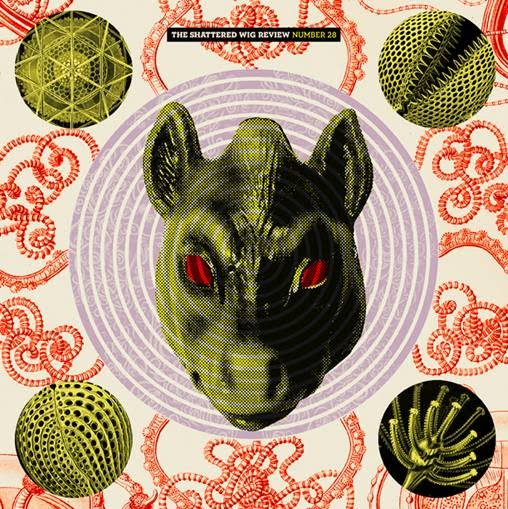
Shattered Wig #28

Shattered Wig #28
Coming In November!

Wednesday, July 4, 2012

Happy 4th!


In the spirit of the new Tea Party and Libertarian America of freedom meaning freedom from all empathy towards other human beings and all humans for themselves, I'm spending this 4th of July watching the Colonel and his droogs shoot off Heckler Koch Machine Guns and beat up on homeless people.  I'm pretty sure unbridled sociopathy is exactly what the Founding Fathers had in mind.

Thursday, June 28, 2012

"The We in Weep": Chris Toll Calls for Revolutionary Love

 Well, the danger in saying yes to writing a book review for a magazine you've never heard of by a guy you've never seen or heard from before is that you'll write the review and never hear back from the editor ever again.  The upside - especially if you knew you loved the book anyway - is that you write a book review and force your (my) feeble brain into forming some kind of passing logic for why you love what you love.


"The We in Weep": Chris Toll Calls For Revolutionary Love in his The Disinformation Phase


  Chris Toll's latest book, The Disinformation Phase (Publishing Genius Press, Baltimore), is awash in the baptismal, transformative fluids of tears and rain: "The rain,/heart in ruins,/staggers out of town"; "Rain sits/in the evicted easy chair"; "Raindrops are calling to the last in love./Them tears are a school that consoles."


   The outside rain mirrors the tears of the protagonists and cast extras in Toll's heartfelt lines. His freely running tears are the lubricant of a soul constantly searching for love - human to human, between nations and interplanetary - and rebirth: "How long can I stay at the inn in innocent?/Love is so hard/and it's all we came to do."


  Of course pleading a case for no holds barred love, is not new in Toll's writing, one of his older books is entitled "Love Everyone" after all, but there is an extra crisp sense of urgency to this collection. Due in part to the compact size - most are from 14 to twenty lines long, only running about an inch across, a few like "National Poetry Month" (5 lines) and "I Expand Before Nebulae" (6 lines), even less - but perhaps also due to the world around Toll in "reality" mutating and rocking ever harder with catastrophes that his "fictional" world of Everything At Once, Batman fighting it out with vampires, worlds teetering on collapse, makes even more emotional sense. 


    A day doesn't go by now it seems without a major earthquake devastating a population, a tsunami reducing humanity to chess pieces swept off the board by a raging loser, droughts, floods, war after war.  Recently the news was so full of cannibalistic violence - a college student eating his roommate's heart and brain, a teenager in Florida eating the face of a homeless man - some people blaming it on the over the counter drug called "bath salts", that the Center for Disease Control felt they had to state that we weren't in a zombie apocalypse since they had jokingly posted on their website over a year ago "How to Survive a Zombie Apocalypse".  It truly does feel that anything could happen at any time and it's hard not to search the skies for some kind of winged hero.


    Because of the naked yearning and whimsy in Toll's writing and the interweaving of lowbrow/pop culture with his more erudite side, I've always thought of him as The Emily Dickinson of Mars. "The Queen of the Vampires" assembles her "army of zombie shamans./They storm Jerusalem and rescue Jesus./No cross is is erected on top of Golgotha." He is as familiar with The Bible as he is with Marvel and DC Comics, Poe and Plath sit comfortably in the mad swirl of zombies, vampires and werewolves. 


  After all, who's to say that in a hundred years sitting in some wretched post-apocalyptic bunker there won't be a surviving tribe of humans passing around Iron Man comic books as sacred text, like the worship of Punchinella in Russell Hoban's novel Riddley Walker?


    Although most of the pieces in Disinformation Phase are not radically different from those of other Toll books (why is "try in Poetry", "why isn't destiny in clandestine" - examples of the kind  of pop linguistic deconstruction that he's been doing since I first became aware of him in the '80s ), but more terse and urgent, this book does herald a new form by him. 


    In the pieces "What Have You Done for Global Warming Today?", "My Ruby Hat", "1776", "Money Never Weeps" and "Writing Groups of the Future", Toll introduces a rich, playful conceit of never before read poems by old masters - John Keats, Emily Dickinson, Dickinson again, Poe and Sylvia Plath respectively - being found under arcane circumstances and then translated by Toll himself.


   The prose introductions to these pieces are transcendentally effervescent and the first time I've seen fiction written by him:  "Correspondence from Emily Dickinson to Arthur Rimbaud was recently discovered in a farmhouse in France.  The three letters were hidden beneath the false bottom in a china cupboard.  Emily and Arthur were both Farsi scholars, and they particularly loved the Rubaiyat of Omar Khayyam." (from "My Ruby Hat")


    Of course part of the humor and twists of these pieces is that after Toll sets up extravagantly bizarre circumstances to how these lost poems of masters are found, he then claims himself as the translator of these works and unleashes wild Tollisms in them, like in "My Ruby Hat":


"I love in 256 Dimensions.
A Prophet devours a Candle -
A Leopard sleeps with a Lizard -
The Word is on the wing."


    Toll's goal is beyond and he wants to reach your heart at any cost, with any tool. "The moon recites the same prayer over and over./Find me soon."


    The final lines of the final poem in the book, "Perfect Love", are a call to break down all walls, including gender, to reach divine love:


"O giant in chains,
O darling ,
let the eternal divine feminine energy
awaken within you."


  I've often heard Chris Toll speak of how "Giants once walked the Earth", like in describing seeing Bob Dylan live during his Highway 61 period and putting the words "Giants will stride the Earth again" in Dickinson's letter to Rimbaud in "My Ruby Hat".  Every impassioned and well crafted line he writes is a call to bring to life the giant that lives in each of us.

Tuesday, June 12, 2012

Before Work

With each question, the doctor's voice
drops to a wispier whisper.
Soon you'll be curled together motionless
on that perfectly stiff paper covered recliner,
forgotten to all but the clicking tick hands of clocks.
There are already two crisp gowns in the room.
The little blood pressure station wheeled in perky
 is like R2-D2 in its robot pal appearance - bright\
 new light industrial rubber and chrome and
padding and gauges.  A thermometer attached
 that only needed six or seven
seconds of your time to let you know
 your factory was not overheating.
With your finger in that pressure
clasp you are the Toscanini of pointers
or perhaps a starter superhero.
 The vibe at the desk is mellow, man.
This is not where the shit goes down, this is
where we find out if you can take the shit
coming down.  You're ready.  Promise.

Monday, June 11, 2012

"To Think It Started With Laurel"


Finally got my new acrylic monster to the point where I felt it was "done".  It started out as an attempt to catch in some form of portraiture  Everly's sweet little niece Laurel from a photo I had taken of her.  Of course it soon degenerated......

Wednesday, May 23, 2012

Taps by Barrett Warner


Barrett Warner is a Baltimore cultural warrior of longstanding.  He served some time in the trenches of the fledgling Shattered Wig Night nights when they were held on Tuesdays, featured four or five poets, 3 or 4 bands and went on until 3am.  But he still speaks to me, as does, surprisingly, Laure Drogoul of the 14 Karat Cabaret where the Wigs are held.

------------------------------------------------------------------------------------------------------


Taps


When they ask about the leg
I don't answer, don't open the window,
Never say, there's a kind of darkness.


A black bruise stains the mind,
The good hurt I hope will mean
I've come far and done something big.

Such sweet aches, loves labors,
The harrowed acres inside,
Ditches dug with pick-axe and spit.

I haven't moved in twenty years
Except to clamber on life's unfinished ledge
When the chair limps into the bathroom.

Changing the light bulb, right?
Those damn blue sparks
Wired to a fault.  The truth

Is that I like the view from here,
Two feet above the rest of the world,
A slip, a jostle from the endless

Swing and sway.  Sometimes I put
Rocks in my shoes if my heels
Aren't sore enough.

 Even after I close the window
And nail it shut the red bird
Will not stop pestering the glass.


--------------------------------------------------------------

Barrett Warner's chapbook Til I'm Blue in the Face was published by Tropos Press. His new poems make appearances in Southeast Review, Slipstream and Quarter After Eight.


Friday, May 18, 2012

A Preview of An Upcoming New Book By Megan McShea

Dear cultural warriors, the forthcoming existence of a new meaty book of Megan McShea on Publishing Genius Press jolts me with the volts of Beyond. It's like there suddenly being an unearthed "new" Lungfish record, finally "discovering" Chicken Rico for the first time, inhaling ocean air on a windy night, walking down a city street and taking pleasure in how your legs feel and there are actually smiling people nearby.

Here is a little preview to whet your brain whistle.

---------------------------------------------------------------------------------

The Appointment

The place was flatter than we had imagined it. We thought it would be a squat tower. But we knew it was the right building from all the friendly notes we'd received on how to make-believe, how to drop things dramatically, how to check our pulses. We rang the bell. The intercom, responding, confused us. It sounded like the ocean, but in a very high resolution, with cries of birds and shouts tossed by waves and even sand under our feet. A young, alert woman finally answered the door, holding it open for us and peering around in the street behind us, gesturing for us to enter the warm foyer.

By the time she shut the door, we had already removed most of our clothing. A pack of dogs startled us and then changed into a flock of soldiers, chasing us into the next room, where a plate of lemon bars and a tea service awaited, only, it was made of wax. "This is nothing like I expected," said my mother, who had persuaded me to join her in coming here. "Well, what did you expect?" I asked. "I thought it would be rosy, like a womb," she said. She sounded sad.

"Change your rabbits!" came a shout from up the stairs, ad then again, descending closer, "change your rabbits immediately!" A man in coveralls appeared with wide black eyes. "Oh, pardon me," he said when he saw us there. "You're not the people I thought you were."

But it was too late, for mother and I had already changed our rabbits.

- Megan McShea

---------------------------------------------------------------------------------------------------

Megan McShea is a frequent contributor to the legendary Shattered Wig Review, and has work in the i.e. reader, Topograph: New Writings from the Carolinas and Beyond, and the forthcoming WORMSBOOK. A collection of her writings entitled "A Mountain City of Toad Splendor" is coming out in late 2012 from Publishing Genius Press. She is also editor and contributor for a book of collaborative writings due out soon-ish from Thingy Press called "Ancient Party". She resides as peacefully as possible in Baltimore.

Thursday, May 17, 2012

Cort Bledsoe's Wonderful Review of My Mole Suit in "Murder Your Darlings"!


Review of Rupert Wondolowski's The Origin of Paranoia as a Heated Mole Suit, poems by Rupert Wondolowski. Baltimore: Publishing Genius Press, 2008.

I met Rupert Wondolowski at a reading in Baltimore hosted by Artichoke Haircut, a local literary journal which hosts amazing readings. (Seriously. Kazoo solos. Sex with octopi. People taking their clothes off without even putting it in the context of a Matthew McConaughey vehicle). This night, Publishing Genius Press was featured. Wondolowski read with Joseph Young (author of Easter Rabbit, a flash collection I blurbed a couple years ago.) Wondolowski blew me away. His poems balanced absurdity with hard-hitting truth. Someone once asked me why I write some of my more absurd pieces, and the only answer I had was that they are more real than most of my straight realist pieces. There’s an oft overused saying that writers ‘lie their way to the truth’ and, in a similar vein, absurdist writers ‘stand their way to the poof.’ Wondolowski brings to mind a line by John S. Hall from “It’s Saturday”: “Sense cannot be made. It must be sensed. And I, for one, am incensed by all this complacency.”

There’s so much humor in these poems, it’s hard to pick out one piece to focus on. A good start is “Steve Fischer Continues,” a poem about the pulp writer of I Wake Up Screaming, and many other pulp books. Wondolowski lampoons the melodrama so often seen in this type of writing while simultaneously paying homage to a master of the genre: “I wake screaming./I scream scratching the dog’s belly in bed,/ scream seeing the third pillow has fallen to the dusty floor.” (lines 1-3).

And what is a heated mole suit? Obviously, it’s uncomfortable and awkwardly unattractive. And if one were wearing it, others would probably react strangely, leading to paranoia. I can’t help but think Wondolowski is talking about the body, the meat suit. In the title poem, Wondolowski waxes melancholic about his childhood (or at least of a child-like narrator): “It’s the loneliest Halloween ever, Charlie Brown. I’m packing my bags for the Patsy Cline Institute for the Emotionally Disabled as chunks of nations are being swallowed or washed away like mashed bananas in a baby’s cereal bowl.” (12-16). Towards the end of the poem, as the narrator sits in his mole suit, he has “an epiphany. All I want is some flatbed truck resonance, a slightly burned picnic table, a clean giddy life of grass stains.” He yearns to return to a more innocent time when he wasn’t concerned about global war, self-image, and the horrors of the world.

The reason that Wondolowski’s poems work isn’t just that they’re funny, or full of pop culture references, or so strange that they instantly invite consideration; plenty of poets are filling their poems with these things these days, juxtaposing Papa Smurf with drug dealers. To be honest, that’s not that difficult to do. The reason Wondolowski’s poems stand out is that there’s something inside the mole suit. And that IS difficult. Wondolowski’s narrator feels like he’s in a mole suit and mocks himself and also mocks that mockery. This is complex stuff and human but Wondolowski refuses to let it sink to the level of melodrama without getting in a few good laughs first. It’s rare for me to find a poet or writer whose work I truly admire, but I admire what Wondolowski’s doing here. His language and imagery are startling, fresh, and insightful. As a matter of fact, before I wrote this review, I ordered his other books. I can’t wait to read them.

-CL Bledsoe

----------------------------------------------------------------------------------

Bio: CL Bledsoe is the author of the young adult novel Sunlight, three poetry collections, _____(Want/Need), Anthem, and Leap Year, and a short story collection called Naming the Animals. A poetry chapbook, Goodbye to Noise, is available online at www.righthandpointing.com/bledsoe. A minichap, Texas, was recently published by Mud Luscious Press. His story, "Leaving the Garden," was selected as a Notable Story of 2008 for Story South's Million Writer's Award. He’s been nominated for the Pushcart Prize 3 times. Bledsoe has written reviews for The Hollins Critic, The Arkansas Review, American Book Review, The Pedestal Magazine, and elsewhere.